Showing posts with label pictorialism. Show all posts

Sunday, 11 August 2013

Printing Onto Wood.

As stated in an early entry, I decided that for my assignment I was going to print an image onto wood. 

Some problems that I expected to run into while doing this assignment were: 
  • most people said that you couldn't use an Inkjet printer for this process, but not having access to a laser printer, I decided to attempt using my Inkjet;
  • I expected to have trouble working out how much of the gel medium I was going to need to use; 
  • I expected to have issues with rubbing off the paper, because I felt I would end up rubbing off the ink as well; 
  • I decided to attempt this in colour, when I had only read tutorials for black and white - as such, I wasn't sure that the colours would come out, which would result in a very faded photograph or no image at all.
Let's start with the process. First, my equipment: a wooden box, white acrylic paint, Matisse Gel Medium, an Inkjet printer, a paintbrush, a roller, and my image. 


This was the photograph I chose to use for my assignment. It's a picture of my mother's dahlias, where I have edited the colours and sharpness to give it more of a pictorialist look. A soft focus and wider aperture were also used to achieve this.

These photographs showed my first attempt at this assignment, which didn't go quite according to plan, but is exactly the same as what I did the second time around bar one thing: the first time around, I painted the box in full before printing the photo to the lid. The second time, I only coated the top part of the box in paint. We will see why shortly. 


One everything was ready, I applied the gel medium to the top of the box in an even layer. The first time I did this, I used a medium sized paint brush and didn't take much notice of my speed. The second time, I used a larger paintbrush and did this quickly, so that the gel medium would all remain wet before the image was applied. 


Once applied, the image and the gel medium were left to dry overnight. Once it was done, I ran the paper under running warm water and began to peel away as much as I could. 

The first time I attempted this, this was where things started to go wrong. I didn't know that acrylic paint became slippery and began to come off once it was wet. As such, I ended up getting paint all over my hands and my image began to rub off in places that I didn't want it to. 

The second time, the rest of the box was paintless while only the side that held the image had been painted. I also used cold water this time, and achieved the effect I was after. 

Overall, I am very pleased with the way my assignment came out: 
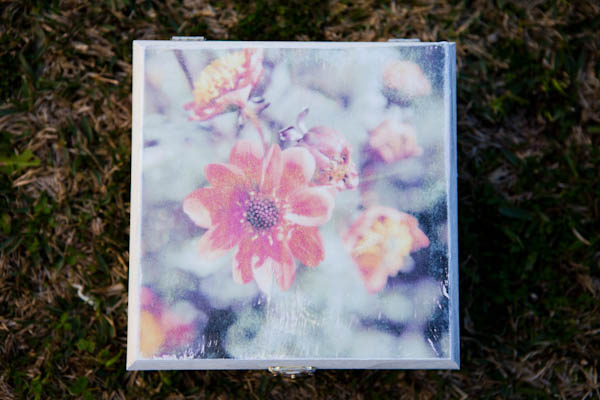

This was finished by applying acid free Mat Spray to the image to protect it.

I quite enjoyed this, as it was both fun and rewarding. I can see myself doing this a lot in future, as such things make for great gifts. Overall, it didn't cost too much either. From the Riot! arts and crafts store that I got all of my materials from, I spent $10 on the box, $10 on a container of paint that still has most of its contents, and $15 on the gel medium while is also still mostly full. Paintbrushes were pre-owned and the roller was $2.

Thursday, 18 July 2013

Printing Onto Wood.

After my last experiment with using an inkjet printer to print onto contact paper failed, I figured I would give using an inkjet printer to print to wood a go - it seemed like an interesting thing to do, given that a majority of tutorials and blog entries I found said that it wouldn't work.

I found a YouTube tutorial where the creator said that she and her sister both used an inkjet printer. Much to my surprise, it was basically the same as every other "don't-use-an-inkjet!" tutorial I had seen: apply a gel medium to the wood, place the print ink-side to the gel, let it dry over night, then remove the paper under running water. 

Obviously, I had my doubts. 


For my test run, I didn't bother leaving it overnight. I let it dry for a few hours and then started the process of removing the paper. As a result, some of the gel medium hadn't dried properly. I ended up rubbing some of it off and getting holes in my image! 


I let the wood dry a few times, and always felt like I still hadn't removed all of the paper. Even now I'm not so sure that I've removed all of it, but I do think that it leaves quite an interesting effect. And either way, I have achieved using an inkjet printer to print on wood! 


The next step is to take a photo to use for this assignment, and then to print it to my wooden box. At this point in time, I'm leaning towards pictorialism as a movement, because printing to wood gives some lovely, old-looking effects that will go well with this.

Monday, 18 March 2013

MY TAKE: Pictorialism and Modernism.

I had planned on using the weekend to catch up on things for my blog - namely taking my own shots in the style of the pictorialist and modernist movements, but I've been sick since Friday and just haven't had the energy to do anything. So today I've gone through some of my old photos instead, and I think I've come across a couple that work. 

Pictorialist

I chose this shot because I feel it fits into the pictorialist category - to me, it looks like it could just as easily be a painting. Nothing is truly sharp. This photograph was achieved by photographing the reflection of this tree in our backyard swimming pool. 

Modernist

Like the previous photo, I feel that this shot fits well enough into the modernist category - most importantly, it is sharp. There has been minimal manipulation to the digital negative (the only editing being to darken around the flower) and it shows exactly what my camera was seeing on the day that I took this shot. 

Wednesday, 6 March 2013

Pictorialism and Secessionism.

Today in class we are looking at these two early photographic movements.

Pictorialism
This style seems to entail taking a photograph and then making it look like a painting. Photographs lacked sharpness, were often printed in one or more colours that were not black and white, and were often manipulated to look like the prints had brush strokes in them. It was a style that developed during the late 19th and early 20th century, and was more focused on making sure that photography was considered an art form than it was on what was actually in front of the camera. Many people believed that the camera was nothing more than a tool to document reality, not create art.

Photo-Secession
Photo-secession came about because of pictorialism. As defined by Wikipedia, it was an early 20th century movement that promoted photography as a fine art in general, photographic pictorialism in general. It was a movement started by Alfred Stieglitz and F. Holland Day, and it held the viewpoint that the importance of a photograph was not what was in front of the camera, but the manipulation done to the image by the photographer so that they could get their vision across.

Pierre Dubreuil
Pierre Dubreuil was a French photographer often referred to as a Modernist who laboured under a Pictorialist veil. He first started taking photos at the age of sixteen, in 1888, but it wasn't until 1896 that he began to become better known in the circle of pictorial photographers. He was also known as a creator of bizarre distoritions.

Between 1904 and 1930 he chose to use the Bromoil process to make his prints. This is a process that often resulted in soft, paint-like qualities, which was popular at the time and has started becoming popular again today.

Pierre Dubreuil
Elephantaisie, 1908.

This is one of his more famous shots, evidently taken in Paris. Although I generally prefer sharper images, I find that I'm quite enjoying the painterly quality of this one. I also like that the subject is something unexpected, that the Eiffel Tower has been pushed into the background in favour of something that I haven't seen a thousand times before.

Pictorialism and photo-secessionism are probably not two movements that I would say I thoroughly enjoy. I don't mind looking at the style every now and then, but they aren't particular styles that I think I would really enjoy trying to portray.