Showing posts with label part 2. Show all posts

Sunday, 11 August 2013

Printing Onto Wood.

As stated in an early entry, I decided that for my assignment I was going to print an image onto wood. 

Some problems that I expected to run into while doing this assignment were: 
  • most people said that you couldn't use an Inkjet printer for this process, but not having access to a laser printer, I decided to attempt using my Inkjet;
  • I expected to have trouble working out how much of the gel medium I was going to need to use; 
  • I expected to have issues with rubbing off the paper, because I felt I would end up rubbing off the ink as well; 
  • I decided to attempt this in colour, when I had only read tutorials for black and white - as such, I wasn't sure that the colours would come out, which would result in a very faded photograph or no image at all.
Let's start with the process. First, my equipment: a wooden box, white acrylic paint, Matisse Gel Medium, an Inkjet printer, a paintbrush, a roller, and my image. 


This was the photograph I chose to use for my assignment. It's a picture of my mother's dahlias, where I have edited the colours and sharpness to give it more of a pictorialist look. A soft focus and wider aperture were also used to achieve this.

These photographs showed my first attempt at this assignment, which didn't go quite according to plan, but is exactly the same as what I did the second time around bar one thing: the first time around, I painted the box in full before printing the photo to the lid. The second time, I only coated the top part of the box in paint. We will see why shortly. 


One everything was ready, I applied the gel medium to the top of the box in an even layer. The first time I did this, I used a medium sized paint brush and didn't take much notice of my speed. The second time, I used a larger paintbrush and did this quickly, so that the gel medium would all remain wet before the image was applied. 


Once applied, the image and the gel medium were left to dry overnight. Once it was done, I ran the paper under running warm water and began to peel away as much as I could. 

The first time I attempted this, this was where things started to go wrong. I didn't know that acrylic paint became slippery and began to come off once it was wet. As such, I ended up getting paint all over my hands and my image began to rub off in places that I didn't want it to. 

The second time, the rest of the box was paintless while only the side that held the image had been painted. I also used cold water this time, and achieved the effect I was after. 

Overall, I am very pleased with the way my assignment came out: 
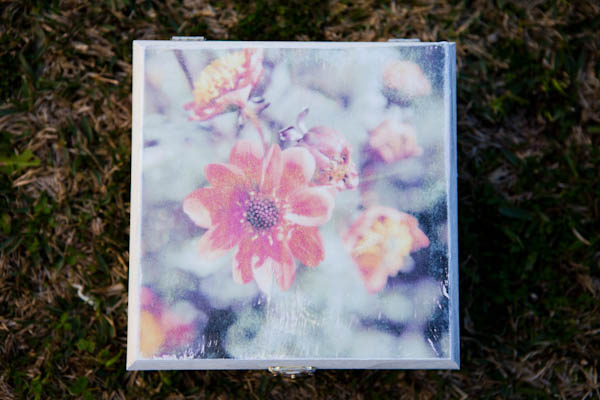

This was finished by applying acid free Mat Spray to the image to protect it.

I quite enjoyed this, as it was both fun and rewarding. I can see myself doing this a lot in future, as such things make for great gifts. Overall, it didn't cost too much either. From the Riot! arts and crafts store that I got all of my materials from, I spent $10 on the box, $10 on a container of paint that still has most of its contents, and $15 on the gel medium while is also still mostly full. Paintbrushes were pre-owned and the roller was $2.

Thursday, 18 July 2013

Printing Onto Wood.

After my last experiment with using an inkjet printer to print onto contact paper failed, I figured I would give using an inkjet printer to print to wood a go - it seemed like an interesting thing to do, given that a majority of tutorials and blog entries I found said that it wouldn't work.

I found a YouTube tutorial where the creator said that she and her sister both used an inkjet printer. Much to my surprise, it was basically the same as every other "don't-use-an-inkjet!" tutorial I had seen: apply a gel medium to the wood, place the print ink-side to the gel, let it dry over night, then remove the paper under running water. 

Obviously, I had my doubts. 


For my test run, I didn't bother leaving it overnight. I let it dry for a few hours and then started the process of removing the paper. As a result, some of the gel medium hadn't dried properly. I ended up rubbing some of it off and getting holes in my image! 


I let the wood dry a few times, and always felt like I still hadn't removed all of the paper. Even now I'm not so sure that I've removed all of it, but I do think that it leaves quite an interesting effect. And either way, I have achieved using an inkjet printer to print on wood! 


The next step is to take a photo to use for this assignment, and then to print it to my wooden box. At this point in time, I'm leaning towards pictorialism as a movement, because printing to wood gives some lovely, old-looking effects that will go well with this.

Sunday, 7 July 2013

Inkjet Printers and Contact Paper.

Although I haven't decided on a photo for it yet, I've been thinking on part two of the assignment and decided that I either want to print on glass or wood - because I love the look of both. 

The catch is that I didn't want it to be expensive, and it needed to be something that I could do at home - so the collodion method was out of the question. With that said, I came across a tutorial that would essentially enable me to make a sticker out of one of my photographs, so that the sticker could then be applied to glass. 

Not exactly printing on glass, but it looked like fun regardless. 

The only problem was that these prints need to be made using a laser printer, as those use toner instead of ink. I decided I would try with my inkjet anyway - I don't currently have access to a laser printer, and I wanted to see if inkjet would work anyway. 

It didn't. 

I printed a high contrast black and white photograph onto plain paper and then stuck a sheet of clear, self-adhesive contact to it - with the ink side of the photo meeting the adhesive side of the contact. I let it dry for a while and then put it into warm water, where I then left it to soak for ten minutes. 

After that you're supposed to rub the paper off the contact, and the photograph is supposed to be left behind. But for me, the ink simply washed away and I was left with a blank sheet of contact paper. 

I plan on trying it again when I have access to a laser printer, but my next experiment will be with wood.